
August is behind us, and the eclipse of the century is now just a fond memory that we won’t experience again for many decades, although we will be able to enjoy two more eclipses soon: a partial eclipse in 2027 and an annular eclipse in 2028. But the sky has much more to offer us, and this September we’ll be able to enjoy two astronomical events organized by the City of Arts and Sciences.
A free telescope viewing night open to anyone who wants to take a peek at the cosmos while summer is still in the air, and a school field day dedicated to promoting science and culture among young people.
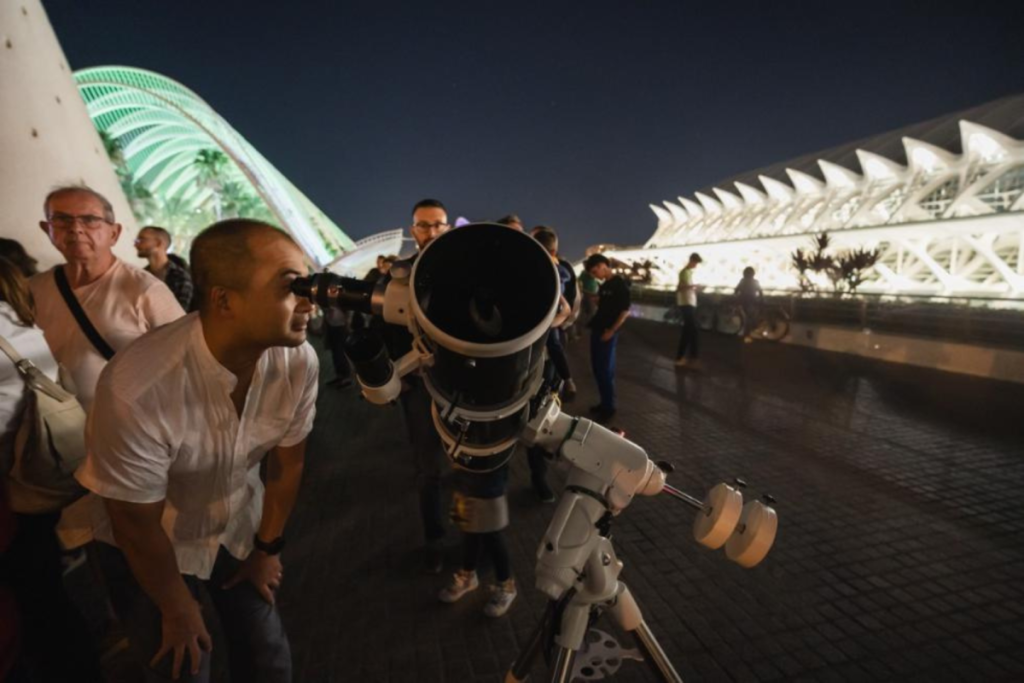
The first event is on September 17 at 9:30 p.m. in the Umbracle Astronomy Garden. Titled “Summer Nebulae, ” this free event—which requires no prior registration— provides the public with five telescopes to observe some of the most striking structures of gas and dust in the sky at this time of year: the Lagoon, Cygnus, Dumbbell, and Ring nebulae.
On September 28, coinciding with International Day of Scientific Culture ( which commemorates the first episode of Carl Sagan’s series *Cosmos* ), the City of Arts and Sciences is organizing an event aimed at middle and high school students.
At 10:30 a.m. in the Santiago Grisolía Auditorium, “Ask a Scientist” kicks off—a talk with Damià Tormo Carulla, who holds a Ph.D. in Immunology and is the recipient of the 2025 Rei Jaume I Award for Entrepreneurial Discovery. The scientist and biopharmaceutical entrepreneur will speak with young people about biotechnology, artificial intelligence, longevity, and entrepreneurship, with a special focus on those who dare to imagine a different future and are working to build it.
Starting at 12:15 p.m., the event moves to the Astronomy Garden for solar observation. Using telescopes equipped with special filters and H-alpha technology, students will be able to examine sunspots on the photosphere and prominences in the chromosphere. Capacity is limited to 300 people, and schools must make a reservation in advance on the official website of the City of Arts and Sciences.