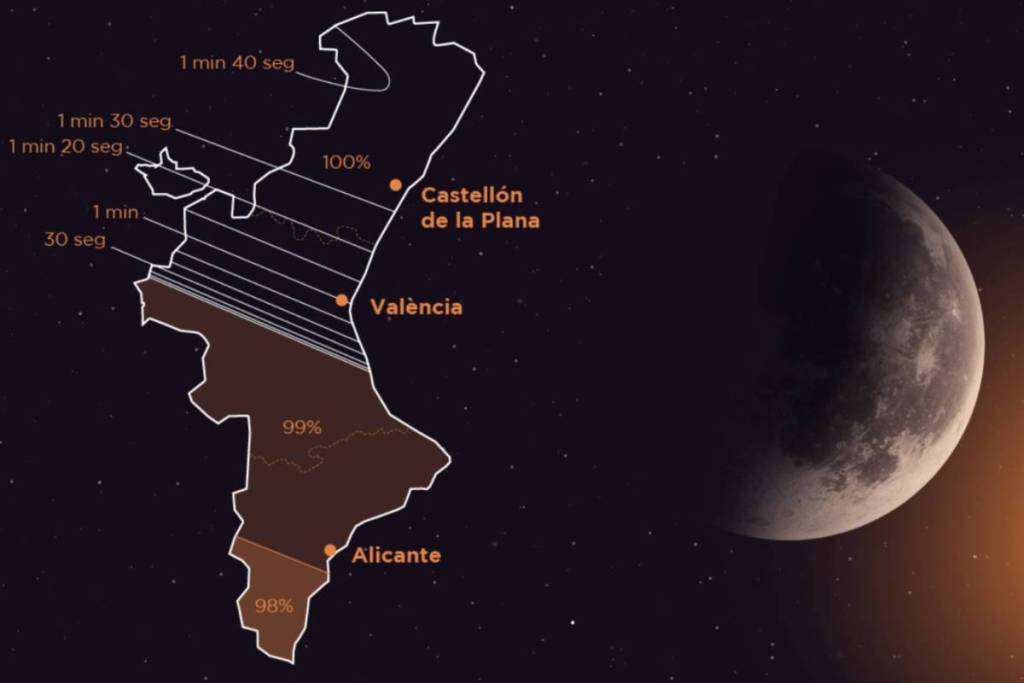

This Wednesday, August 12, we will experience one of the most impressive astronomical phenomena visible from our planet: the total solar eclipse. In the Valencian Community, we haven’t had the chance to witness a natural spectacle like this in over 120 years (since August 1905), and this time we’ll be able to enjoy it in the northern half of the region.
The entire province of Castellón and a large part of the province of Valencia are within the totality zone, while the rest of the region will be able to enjoy a partial view of 99 or 98%.
However, simply being within the path of totality does not in itself guarantee a good view of the event. The eclipse will occur between approximately 7:30 p.m. and 9:15 p.m., which means the sun will be very low in the sky, so it’s important to check in advance that there are no buildings or obstacles blocking the view from your chosen location .
To facilitate viewing and ensure it is done safely, the Valencian Regional Government has established 9 official observation points with a total capacity of 85,000 people, where total visibility is guaranteed and safety and emergency response teams will be on hand.
Official viewing locations in Castellón
Castellón is one of the best provinces in the entire country for viewing the eclipse. Some municipalities will experience the phenomenon for more than a minute and a half, which is why up to four observation points have been set up.
Although some are located in towns quite far from Valencia, three of the four locations can be reached by public transportation.
In the northernmost part, we find the Peñíscola viewing site: located in the park-and-ride lot, it can accommodate up to 5,000 people and will feature restrooms and facilities adapted for people with limited mobility. Additionally, this is a town with a lot of tourist activity, so you can round out your visit by dining at its restaurants or staying at one of the available accommodations.
Benassal is another of the locations chosen by the regional government to view the event, specifically the Sant Cristòfol Chapel. This rural site can accommodate about 1,000 people; however, although it has restrooms, it is not accessible to people with limited mobility, and its location makes transportation more difficult.
Onda Castle is another official viewing site; with a capacity for 1,000 people, it offers a perfect view of the horizon alongside a historic part of the city. Access is open to the general public; restrooms are available, and visitors can stay overnight in accommodations within the municipality.
Finally, the beaches of Castellón de la Plana can accommodate more than 60,000 people. This prime location for enjoying the phenomenon stretches along the entire coastline (from the planetarium to the river). The area is accessible to people with limited mobility and will feature public restrooms to serve the large number of visitors expected.
Official viewing locations in Valencia
Only the northern half of the province of Valencia will be able to see the eclipse in its entirety, and the closer we get to the border with Castellón, the better the visibility will be. However, the province has five official observation points distributed throughout the territory:
At the southernmost point of the total visibility zone lies Macastre, a rural municipality situated at an elevation of over 400 meters. An observation point with a capacity for about 1,500 people will be set up at the town’s medieval castle. It does not have restrooms, but contrary to what one might think given the setting, it is accessible to people with limited mobility.
In Utiel, at the La Celadilla municipal soccer field, another team from the Valencian Regional Government will be on site to assist and guide people during the event. The venue has a capacity of 600 people, is equipped with restrooms, and is accessible to everyone.
At the Aras de los Olmos Observatory —probably the best spot in the entire province to experience the event—another viewing area has been set up for anyone who wants to travel there to witness it at this iconic location. The maximum capacity is about 5,000 people, but it’s important to note that the site is not wheelchair-accessible and does not have restrooms.
Puçol Beach has also been designated as an observation point for about 1,000 people. It has restroom facilities, but it is not accessible to people in wheelchairs or those with mobility challenges.
Finally, Malvarrosa Beach in Valencia will also be set up for viewing the phenomenon and will have space for about 10,000 people, with accessible facilities for people with limited mobility and extensive security and public transportationarrangements to ensure the well-being of attendees.