The Valencia City Council has presented this Wednesday the project of a new 1.3-kilometer cyclopedestrian path that will link the final stretch of the old riverbed, from the Penya-roja neighborhood to the Astilleros bridge, to connect the districts of Poblats Marítims, Camins al Grau and Quatre Carreres.
The new infrastructure, promoted in the framework of the European Green Capital 2024, has a budget of more than 2 million euros, co-financed by the Generalitat, and it is expected that the works can be tendered in early 2026 so that the path will be in service in early 2027, after an estimated execution period of eight months.
“The objective is that this project, which is definitive, connects the Parque de Cabecera with the future Parque de Desembocadura, and thus fulfill our aspiration to connect the city with the sea,” said the mayoress during the presentation.
A route of 1.3 kilometers with a new footbridge
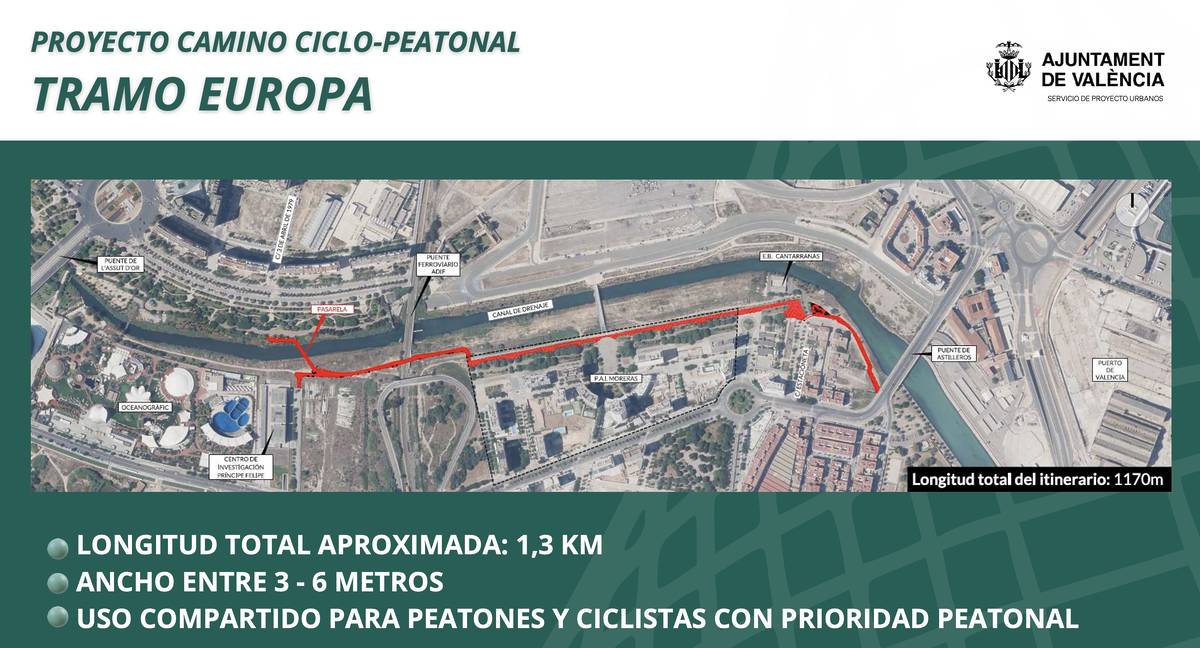
The new route will have an approximate length of 1.3 kilometers and a variable width of between 3 and 6 meters. It will start on the left bank of the old Turia riverbed, at the height of 3 d’abril de 1979 street (Camins al Grau district).
The central element of the project will be a 54-meter long metal footbridge that will cross the riverbed to connect with the right bank. According to Catalá, this structure has been designed after an exhaustive hydraulic study to guarantee safety in the event of possible flooding, since important city sewers converge in this area.
Once on the right bank, the path will continue through the PAI de les Moreres (Quatre Carreres), passing under a railway bridge of the Serradora tracks through an existing underpass that will be conditioned to improve its accessibility and integration.
The route will end near the Canta-ranes building, where it will fork into a cycle path and a pedestrian path to reach the Astilleros bridge, already in the Poblats Marítims district.
The design of the path will prioritize pedestrians and will be equipped with rest areas every 50 meters, trees, litter garbage cans, bike racks, video surveillance and a solar lighting system with presence sensors that will increase its intensity in the darkest areas.
The mayor has taken the opportunity to reiterate its request to the Government of Spain to undertake the burial of the tracks of the Serradora, an infrastructure that, in his view, is a “railway scar” that prevents the full connection of the city with the sea.
This action is part of a broader plan that includes the urbanization of the PAI del Grau, which will provide more than 160,000 square meters of green areas, and will culminate with the future Parque de Desembocadura, described by the mayor as “the great green infrastructure of this decade in Valencia”.