
We tend to think that downtown Valencia no longer holds any big surprises for locals, that it has become a sort of tourist trap with inflated prices and restaurants offering paella and Aperol combos at 6:00 p.m. And, while it’s true that the streets and squares of Ciutat Vella have changed a lot in recent years, there are still many historic and hidden corners that most Valencians are unaware of.
We’ve all seen or visited the Church of San Juan del Hospital at some point— Valencia’s oldest religious monument. But what most people don’t know is that its interior houses a 13th-century cemetery and the remains of a former empress of Greece, along with three relics she protected throughout her life.
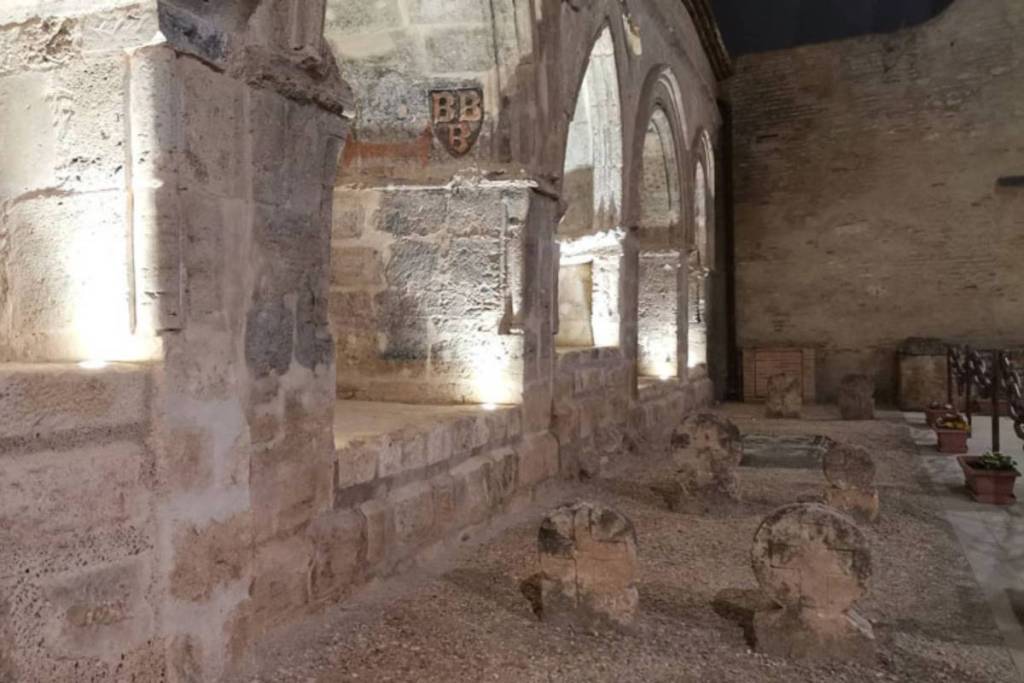
The medieval necropolis of San Juan del Hospital is one of the most exceptional sites in the entire city: it is the only urban cemetery in Valencia to have survived the test of time, and located in the monument’s southern courtyard is the Chapel of King Don Jaime, a funerary structure notable for its distinctive Gothic-Cistercian architecture and the only one of its kind still standing in Europe.
The Empress of the Greeks, Her Journey, and Her Relics
But the most surprising thing about this cemetery may not be its architecture, but rather what it hides inside: the body of Constance of Hohenstaufen, the Empress of Greece, along with her relics. The daughter of Frederick II, Holy Roman Emperor, she married John III, the Byzantine Emperor of Nicaea, and became empress consort of the Byzantine Empire.
After her husband’s death and finding herself caught up in the war over the Byzantine throne, she fled to Sicily, where she encountered only more conflict and the death of nearly her entire family. Following this massacre, the former empress sought refuge in the Crown of Aragon—more specifically, in Valencia—where she remained until the end of her days.
According to legend, Constanza fled Sicily with practically nothing, except for three sacred relics of inestimable value at the time: a fragment of the porphyry column (where Saint Barbara was bound and tortured), a stone from which water miraculously sprang so that the saint could be baptized, and a bone from her arm. She donated all of these to the Church of San Juan del Hospital, along with money to build a chapel dedicated to the saint she venerated.
After her death, she was buried with the rest of the bodies, but her remains were later transferred to the Chapel of Santa Bárbara (which she herself had commissioned to be built inside the church). In that space, which can be visited within the church grounds, the relics that the empress brought to Valencia are on display .