

Valencia comes to a standstill this Wednesday, November 11, due to the general strike protesting the housing crisis in Spain. The mobilization, called by the Tenants’ Union and supported by the country’s main labor groups, demands regulation of the housing market, across-the-board wage increases, and greater control over inflation and the cost of living.
In the Valencian Community, marches have been organized in the region’s most populous municipalities: Elche, Castellón de la Plana, Alicante, and Valencia are the sites of most of the protests, although the main demonstrations will begin at 6:00 p.m. in all four cities.
November 11 Protests in Valencia: Schedule, Route, and Traffic Closures
Although the Valencia City Council has not yet released information regarding which roads will be closed to traffic, we do know the starting point and destination of the marches in the city:
- The main demonstration will begin at 6:00 p.m. on Xàtiva Street and end at the Plaza del Ayuntamiento, in front of City Hall.
The exact route is unknown, but the marches usually proceed along Colón Street to the Porta de la Mar and, from there, turn onto the Parterre, continue along Paz Street, and reach the Town Hall Square via San Vicente Mártir Street.
However, other protests have been called throughout the day to complement the main mobilization:
- Between 5:00 a.m. and 6:00 a.m., labor unions have called for protests and morning picket lines in logistics and transportation hubs such as the EMT bus depots, Metrovalencia workshops, access points to the port, Mercavalencia, and industrial parks.
- The teachers’ unions have called for a rally at 11:00 a.m. in front of the Regional Ministry of Education (Avenida de Campanar, 32), which will set off at approximately 11:45 a.m. toward the Town Hall Square.
- At 12:30 p.m., the morning rally for housing—organized by the unions and scheduled to take place in Town Hall Square—will begin.
- Student assemblies have organized an educational march at 5:00 p.m. starting from the Torres de Quart to wind through the streets of the historic center until joining the main demonstration at 6:00 p.m.
Public transportation: minimal service on buses, the metro, and trains
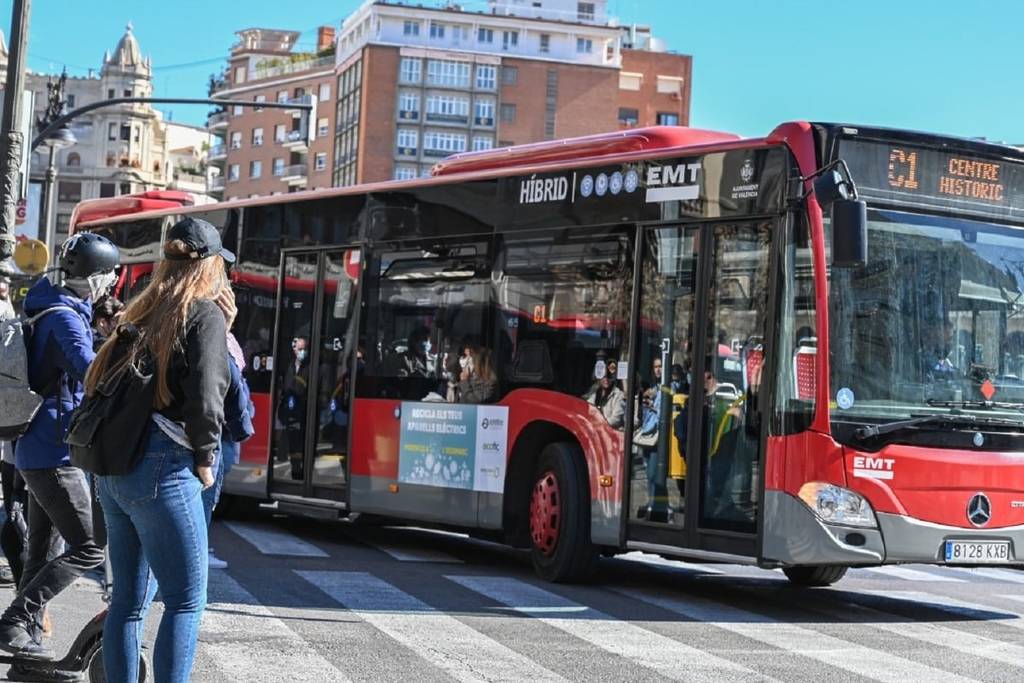
The Valencian Regional Government has mandated a minimum service level of 80% for Metrovalencia and EMT buses, while the Metrobús service will operate at 80% capacity during peak hours (from 6:30 a.m. to 9:00 a.m., 1:30 p.m. to 3:30 p.m., and 6:30 p.m. to 9:00 p.m.) and at 70% during off-peak hours.
The regional government has set these percentages due to the lack of alternative public transportation options for getting around the city. However, EMT buses (and Metrobús on part of its route as it passes through the city center) may experience detours and delays as a result of traffic disruptions. We recommend checking the routes of the various lines and any possible changes via the official EMT app or its website.
The rest of the intercity bus routes will operate at 80% capacity on routes to the airport, at 50% on routes to industrial parks and workplaces, at 55% on regular routes during peak hours, and at 40% on those same routes during off-peak hours.
Commuter, Medium-Distance, and High-Speed Trains: Train Cancellations
Renfe’s commuter rail service will operate at 75% capacity during peak hours: from 6:00 a.m. to 9:00 a.m., from 1:30 p.m. to 3:30 p.m., and from 6:30 p.m. to 8:30 p.m. During the rest of the day, service will run at 50% of normal capacity.
Renfe’s Medium-Distance trains will operate 65% of their regular services, while Long-Distance and High-Speed trains will run 73% of their usual routes. In addition, Iryo will operate at 72.7% capacity and Ouigo at 69.2%.
The following trains originating in or bound for Valencia will be canceled or are not guaranteed by the operating company:
- The Ouigo train from Madrid Chamartín to Valencia Joaquín Sorolla (departing at 7:15 a.m.) has been canceled.
- The Valencia Joaquín Sorolla–Sevilla Santa Justa AVE train (departing at 9:15 a.m.) has been canceled.
- Service not guaranteed: Iryo Madrid Chamartín – Valencia Joaquín Sorolla (departure at 9:30 a.m.)
- The Ouigo train from Valencia Joaquín Sorolla to Madrid Chamartín (departing at 10:27 a.m.) has been canceled.
- The Madrid Chamartín–Valencia Joaquín Sorolla AVE train (departing at 11:30 a.m.) has been canceled.
- The Iryo Valencia Joaquín Sorolla – Madrid Chamartín train (departing at 12:27 p.m.) is not guaranteed to run.
- The Valencia Nord–Cartagena long-distance train (departing at 3:05 p.m.) has been canceled.
- The Valencia Joaquín Sorolla–Cuenca Fernando Zóbel AVE train (departing at 4:35 p.m.) has been canceled.
- Service not guaranteed on the Iryo Madrid Chamartín–Valencia Joaquín Sorolla route (departure at 4:45 p.m.)
- The Ouigo train from Madrid Chamartín to Valencia Joaquín Sorolla (departing at 6:15 p.m.) has been canceled.
- The Iryo Valencia Joaquín Sorolla – Madrid Chamartín train (departing at 7:53 p.m.) is not guaranteed to run.
- The Ouigo train from Valencia Joaquín Sorolla to Madrid Chamartín (departing at 8:57 p.m.) has been canceled.
The general strike coincides with the mobilizations called by the Renfe train drivers’ union, which has organized a total work stoppage for Tuesday, November 10, and partial work stoppages on Thursday, November 12, during the following time periods: 6:20 a.m. to 9:20 a.m., 2:20 p.m. to 5:20 p.m., and 9:20 p.m. to 11:20 p.m.
Affected passengers may request a full refund of the ticket price for canceled trains within a maximum of 30 days, and financial compensation ranging from 25% to 50% of the ticket price is available based on the length of the delay. Delays that force affected passengers to stay overnight must be compensated with payment for lodging and transportation to the hotel.
Elementary schools, high schools, and school cafeterias: Are classes in session on November 11?

Schools in the Valencian Community will open their doors with minimum services, established to ensure the care and safety of students. In public, private, and state-subsidized schools alike, a minimum number of teachers per classroom and student has been set to ensure the school’s operation, although classes will most likely not be held as usual so as not to disadvantage students participating in the strike.
School meal services are also continuing with 60% of the staff (80% in centers for children ages 0 to 3 and in special education), and school transportation is operating at 50% of its usual capacity. Students in the third year of ESO and above may be absent without being marked absent or facing disciplinary action.
Healthcare, emergency services, and pharmacies
Coverage for essential medical procedures will continue as usual, while outpatient services will see reduced operations. However, emergency rooms will operate with the same staffing levels as on a Sunday or holiday.
Specialist appointments have been reduced to 25%, with only urgent or priority appointments being maintained; health centers and primary care facilities will provide their usual Saturday services. Ambulance service will remain at 100% capacity for SAMU and Advanced Life Support, and at 80% for Basic Life Support and non-urgent medical transport (TSNU).
Only those pharmacies that are on call or provide emergency services will be required to open. Whether other pharmacies open will be left to the discretion of their owners and employees.
Pay cuts and workers’ rights
Going on strike is a labor right that involves losing pay for that day, but it protects your job and basic working conditions. If you decide to participate in the protest, your contract is legally suspended temporarily, and your pay will be deducted proportionally from your total monthly earnings.
During those 24 hours, you are considered to be on “special leave” and do not make social security contributions, but your contract remains active, and the company cannot penalize you in any way for this.